The San Francisco Arts Commission
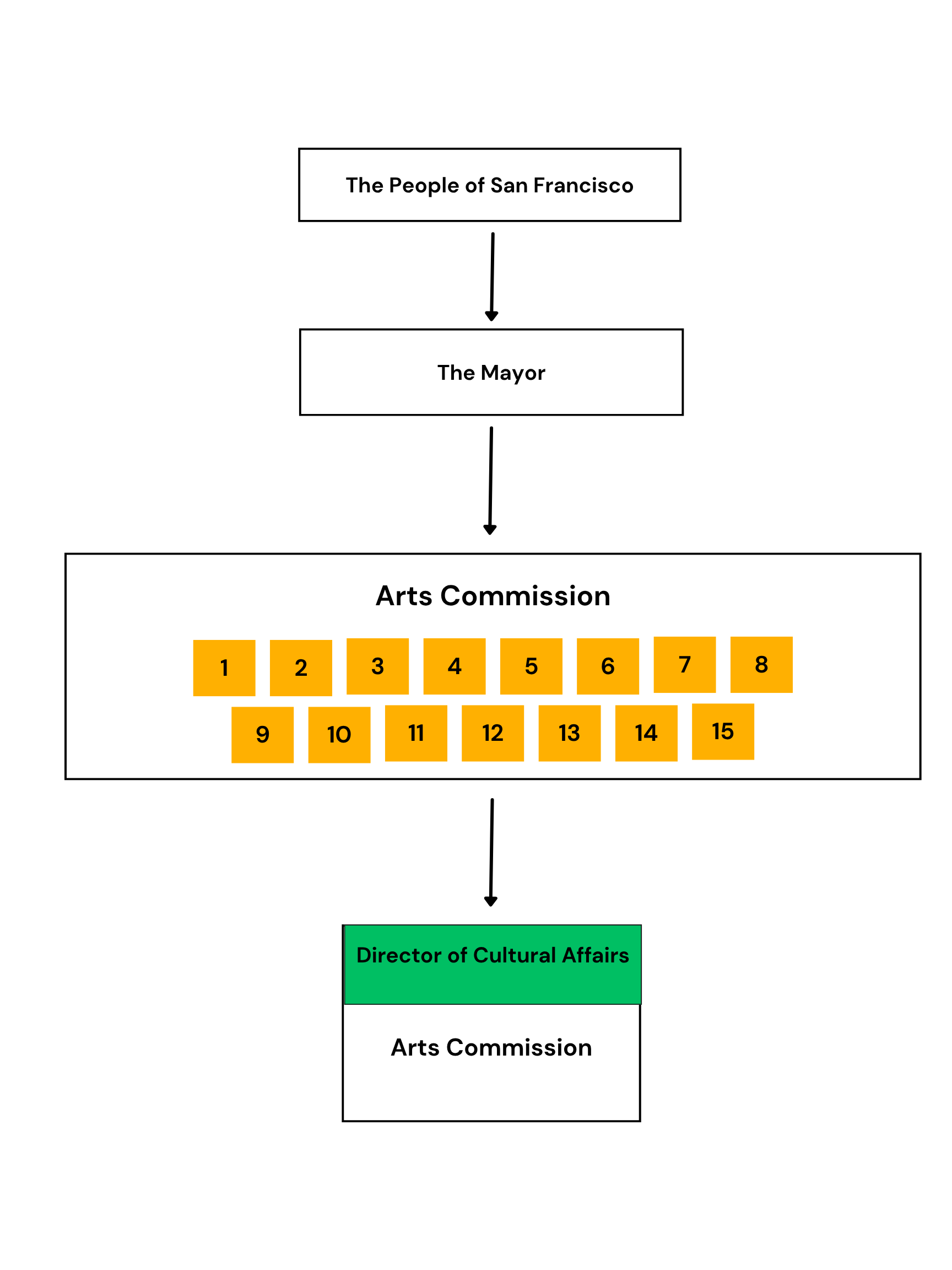
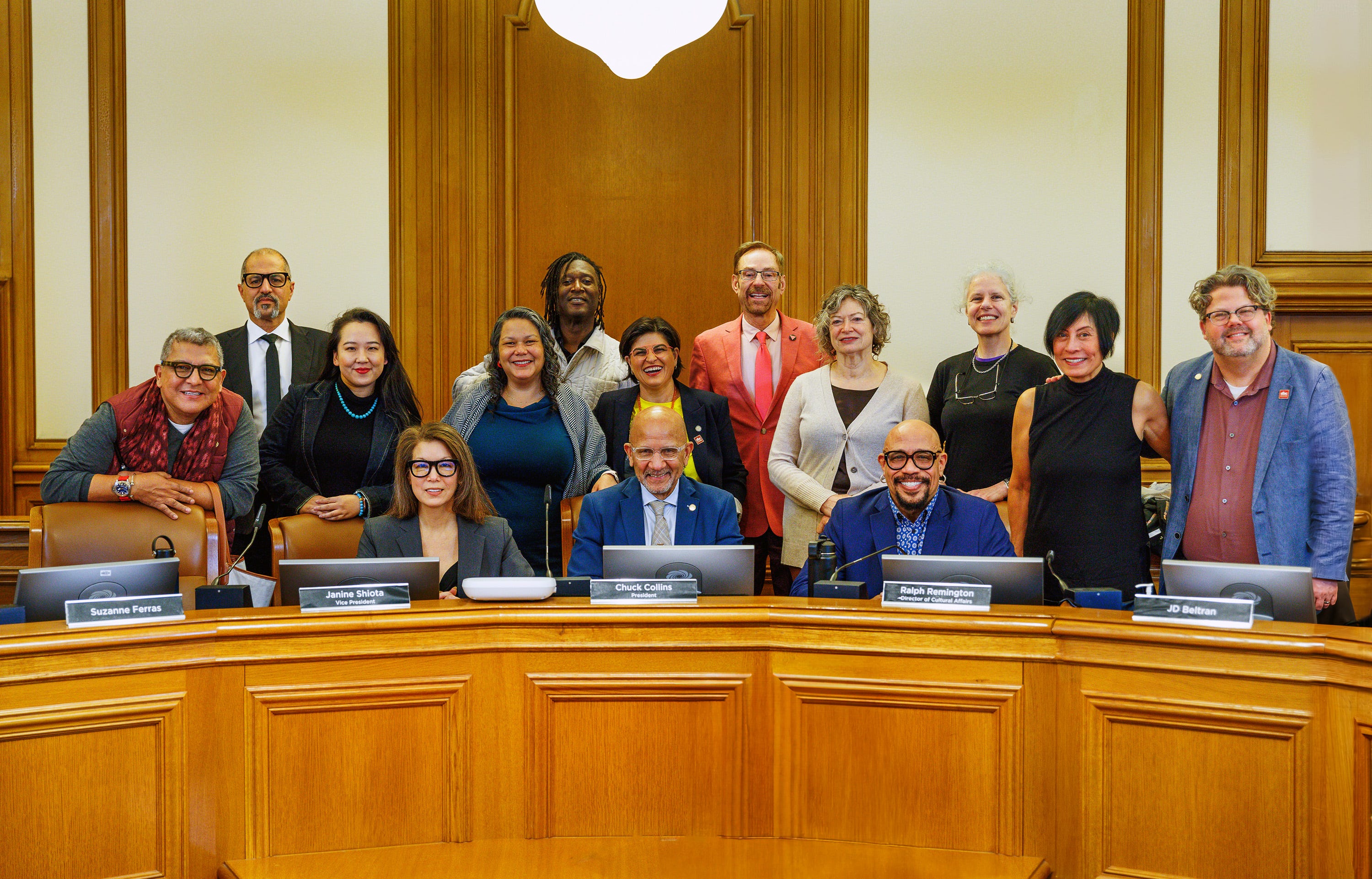
The San Francisco Arts Commission is an agency that consists of fifteen members appointed by the Mayor for four-year terms. No Board of Supervisors control here. Eleven members must be “practicing arts professionals including two architects, a landscape architect, and representatives of the performing, visual, literary and media arts; and four members shall be lay members. The President of the Planning Commission, or a member of the Commission designated by the President, shall serve ex officio. Members may be removed by the Mayor.”
They are overseen by the Director of Cultural Affairs.
Two seats are currently vacant.
The commission was established under the 1932 San Francisco Charter.
The Arts Commission (15 member volunteer board) runs the Arts Commission (city agency with paid staff). It’s nice they both have the same name so no one gets confused!
How do you get money?
If you’re an artist, you apply for a grant, a panel scores and reviews the projects, and the Commission hopefully approves your grant.
Who decides what art goes on a site?
A selection panel made up for artists, community reps, and staff) recommends artists and proposals. They encourage public comment on proposals. Then the Arts Commission approves.
How much money are we talking about here?
For the 2025-2026 grant cycle, they awarded “$10.4 million to support 151 grantees, including more than $7.5 million in grant funding awarded to 98 individual artists and 47 arts nonprofit organizations, and nearly $3 million in funding support has been awarded to support cultural centers.”
There two main laws to know about:
Art Enrichment Ordinance (the 2%-for-art program)
In 1969, the Art Enrichment Ordinance (the 2%-for-art program) was enacted which is how public art is paid for for city construction. Two percent of the gross construction cost is set aside for public art.
This can be a significant amount. For example, the remodel of Terminal 2 at SFO Airport generated about $3.7 million in art enrichment funds.
What about art in POPOS (Privately-Owned Public Open Spaces)?
1% Art Program that requires all projects involving new building, or the addition of 25,000 square feet or more in the Downtown, SOMA, Dogpatch, and some other neighborhoods, provide public art equal to at least 1% of the total construction cost. It was established by the 1985 Downtown Plan and is governed by Section 429 of the Planning Code.
Since May 2012, developers can also choose to allocate their 1% to the City’s Public Art Trust instead or they can split the 1% between art on site and money to the trust.
Since May 2012, some projects may choose to dedicate a portion of their 1% Art requirement to the City’s Public Art Trust. To read more about the requirements, and the Public Art Trust, please read the Public Art Requirement Fact Sheet.
Recent changes
There have been recent controversial changes where they used to front a large amount of money to artists without much oversight and now they require much more paperwork and check-ins and focus more on reimbursement.
Payment advances will be capped at 50% (they used to do as much as 70%) and they will need to submit quarterly reports on spending and deliverables.
But after much pushback, they paused the changes until probably sometime next year.
1. Resources
Media
SF Chronicle article: S.F. arts community fears for its future as City Hall eyes stricter control of grants (06/28/25)
Public/Gov Sources
San Francisco Arts Commission policies (website)
Legal Sources
SF Charter, Charter § 5.103. Arts Commission.
SF Administrative Code, § 2A.150. Arts Commission; Functions, Powers and Duties.
SF Administrative Code,§3.19. Appropriation for Art Enrichment of Proposed Public Buildings, Aboveground Structures, Parks and Transportation Improvement Projects.
SF Administrative Code § 429. Artworks, Options to Meet Public Art Fee Requirement, Recognition of Architect and Artists, and Requirements
Experts to contact
Director of Cultural Affairs, Ralph Remington (email for his secretary)
Ex. Officio, SF Planning, Lydia So
2. Simple Map